

Impirar, impirar, che el tempo el pol passar - Threads of Light
- Focus Area: tbd
- Region: Veneto Region
- About Laboratory: The CLL originates from the history of the impiraresse, the Venetian women engaged in the manual threading of glass beads, an activity that unfolded within a collective dimension made of conversation, presence and repeated gestures. The Venetian saying “Impirar, impirar che el tempo el pol passar”, shaped here through knotted threads that materialise the act of writing, introduces a relationship between labour, rhythm and duration, suggesting a sense of time built through continuous making. These reflections take shape in a chandelier that evokes the natural light accompanying the impiraresse in their work, making it possible to share gestures and dialogue. The chandelier condenses natural light into a suspended form, evoking the relational environment in which shared labour took shape. Harnessing the expressive power of beads, combined with prompts, participants can then create their own “Emotional Sample Book”, a personal palette of colours and impressions responding to the stories of the calli and the people who inhabit them.
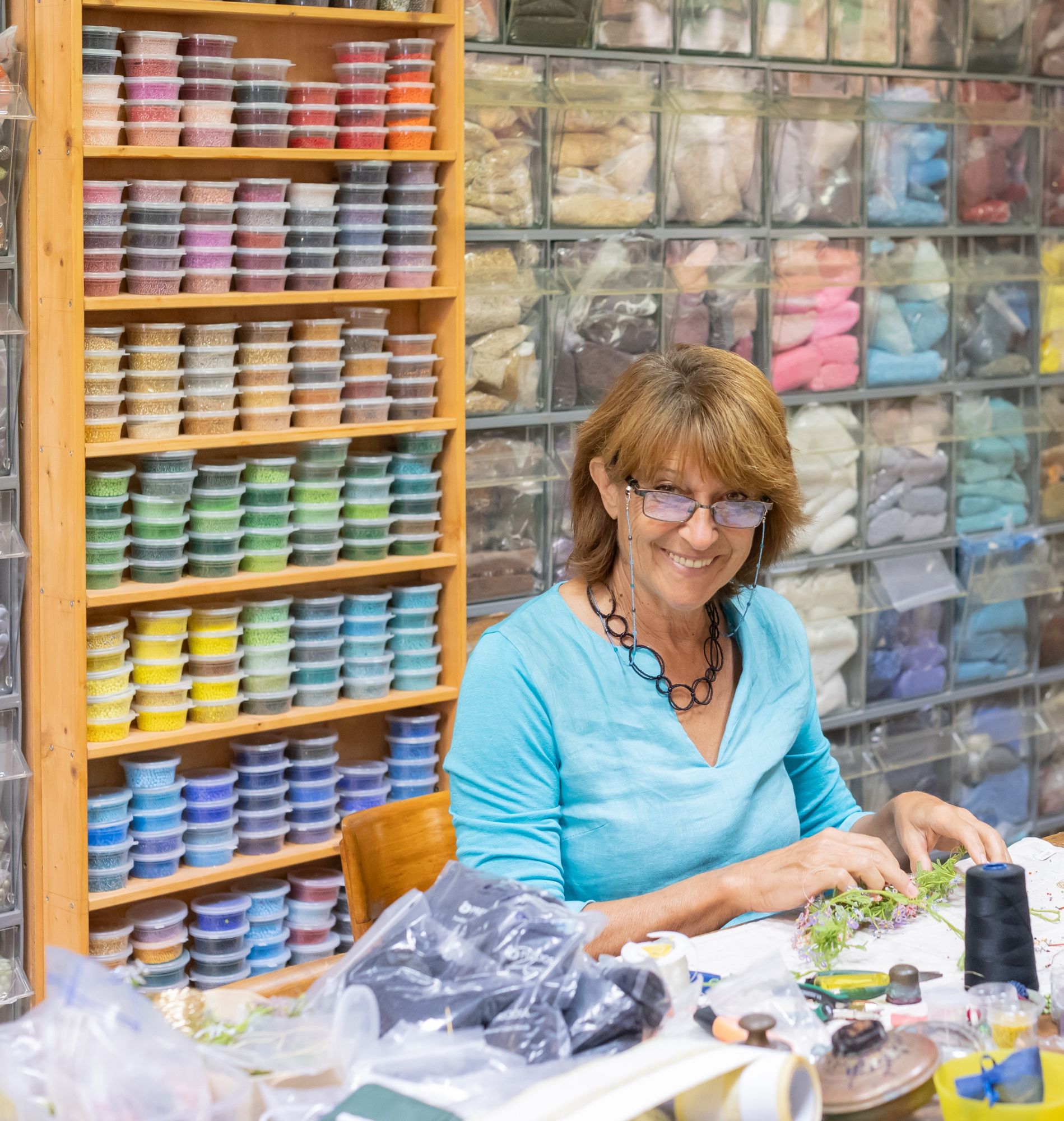
- Region: Veneto
- Artistic Focus: Impiraressa, Bead stringer
- Name and surname: Luisa Conventi
- Website: https://www.dittagioia.it/
- Info:
My company continues a family tradition begun by my grandfather Aurelio, who around World War II produced and sold glass-bead necklaces near Venice’s railway station. In 1950 my uncle Antonio opened a workshop where he created floral and millefiori necklaces and original glass-bead jewelry that reached the world of high fashion.
Fascinated by this craft, in 1987 I founded Ditta Gioia, later moved (2007) to our family’s historic premises in Calle Priuli. For over thirty years I have created jewelry combining tradition and innovation. Over the years, I have organized public events with demonstrations, talks and storytelling to promote the heritage of the impiraresse and, together with the Committee for the Protection of the Venetian Bead, contributed to achieving UNESCO recognition. In 2022 I transformed my workshop into a small museum dedicated to the history of seed beads and the impiraresse.

- Region: Veneto
- Artistic Focus: Visual Artist
- Name and surname: Barbara Prenka
- Website: https://barbaraprenka.cargo.site/
- Instagram: https://www.instagram.com/barbara_prenka/
- Info:
Barbara Prenka (1990, Gjakova, Kosovo) lives and works between Bolzano, Berlin and Brescia. She obtained both her BA and MA in Painting at the Academy of Fine Arts in Venice under the supervision of Carlo Di Raco. Her practice unfolds through installations and textile-based works that activate matter as a relational space, exploring manual gesture as a temporal and collective practice.
Among her recent solo exhibitions are What Lies Behind the Boundaries of a Shadow? (Lottozero), What time is it between my fingers? (A plus A Gallery, Venice), and Covers (Arthouse, Shkodër). She has exhibited in international institutions and galleries including Kunstquartier Bethanien (Berlin), Secci Gallery (Pietrasanta), Clima (Milan), and the National Gallery of Kosovo, and has participated in art fairs such as SWAB Barcelona and Artissima Torino.
She has taken part in residencies at Lottozero, Palazzo Monti and Bocsart, and is a recipient of the Premio Fabbri and the Combat Prize.

- Region: Veneto
- Artistic Focus: Trade Association
- E-mail:
This email address is being protected from spambots. You need JavaScript enabled to view it. - Website: https://www.artigianivenezia.it/
- Info:
Confartigianato is the main Italian confederation representing small and micro craft enterprises. It operates through a nationwide network of regional and provincial associations that provide representation, services, training and advocacy for artisans and small businesses.
Confartigianato Imprese Venezia contributed to the CLL by situating the impiraressa’s atelier within the historical continuum of Venetian bead craftsmanship and contemporary micro-enterprise practice. Drawing on its familiarity with lagoon craft professions and heritage economies, the association provided cultural framing on the evolution and of traditional beadwork. This perspective reinforced the lab’s focus on the transmission and renewal of artisanal knowledge; in addition, the association acted as an operational interface with local institutions and networks, helping coordinate stakeholder involvement and audience participation around the residency and its public outcomes.